
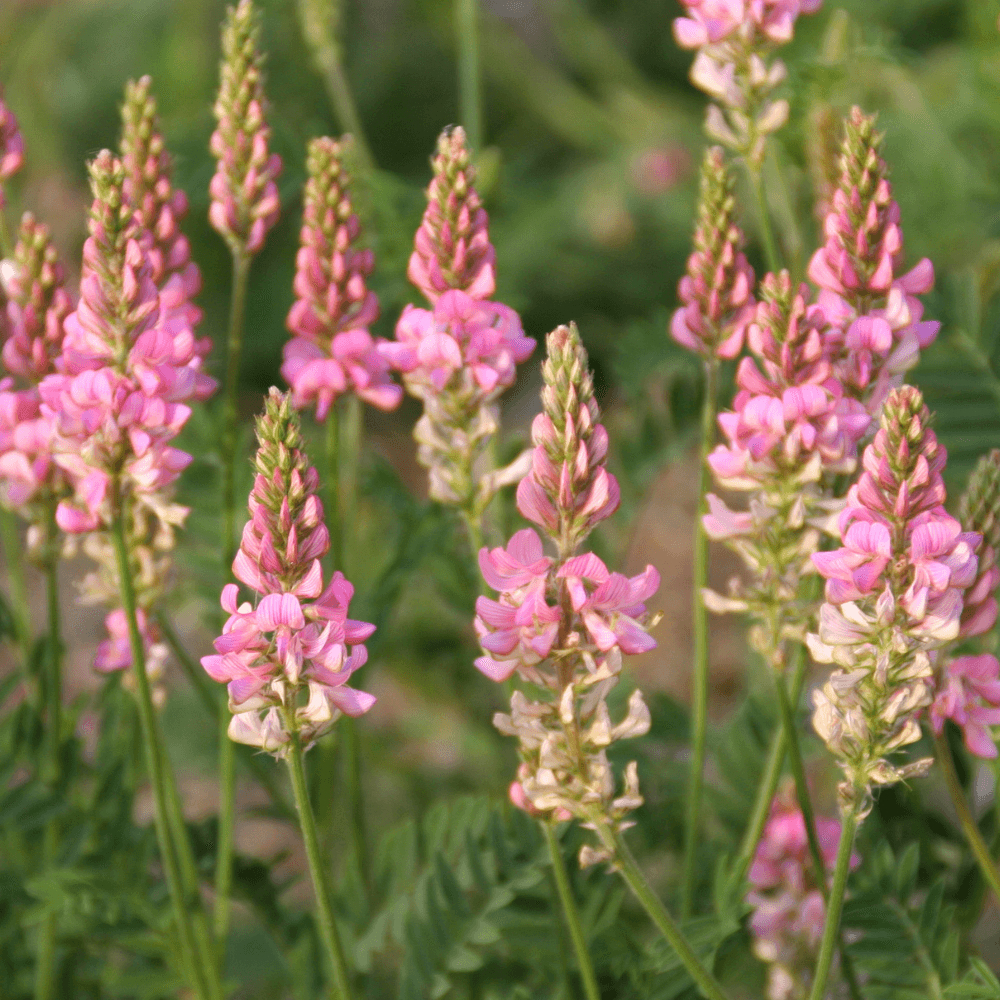
Sainfoin (UK) or Holy Clover (US) is a perennial (survives year on year), temperate (mild temperate climate), leguminous (plant family including peas, beans, and lentils), forage (animal feed grazing plant) crop that can grow in poorer soils, is drought tolerant, excellently suited to low input and organic farming, and supports improved soil fertility..
It’s been growing natively in temperate Europe and Asia for centuries, and was introduced to north America in the early 1900’s. It’s one of those traditional forage plants, which were vital and commonplace as forage crops for horses and livestock before artificial nitrogen fertilisers and rich modern ryegrass species. Its name is thought to come from the old French dialect for ‘Sainte’, which is holy, and ‘Foin’ which is hay, making Sainfoin loosely translatable as ‘holy hay’, illustrating just how important it was.
It has been the subject of greater attention by way of research and agriculture in recent years, because of unique characteristics that provide benefits across its whole lifecycle as a forage feed.
These benefits can be summarised as coming from key areas:
- Unique nutrient profile
- Bloat reduction
- Protein digestibility
- Anthelmintic properties
- Benefits to pollinators
- Environmental advantages
The relevant nutrients of sainfoin
As is common for plants in the legume family, sainfoin is higher in protein as a forage than meadow hay variants, and in overall nutritive value generally. Research that has assessed the impact of pelleting has shown that its unique properties and nutrition are largely unaffected by this process, and therefore horses can benefit from sainfoin forage when fed fresh, dry or pelleted.
Sainfoin contains a wide array of polyphenols, which are naturally occurring compounds in plants. They vary considerably in type and purpose, and are a large part of the varying uses and nutritive qualities of plants. They can be used by the plant for controlling growth, physical structure, UV protection, frost protection, predator and microbe deterrence, colour, ripening, and preservation.
They are why different plants can have such unique health benefits, and contribute to a healthy and more diverse microbiome, when we include varieties of plants/vegetation in our diets.
The biological activity of polyphenols can vary greatly, as they are a family of compounds and therefore vary widely by the species of plant. They can vary greatly in chain length and ‘astringency’ which is a measure of interaction with proteins, cells and digestive contents.
When sainfoin has been tested using chemical chromatography and spectroscopic methods, which identify the specific compounds present, all the parts of the plant contain polyphenols. And the plant as a whole has a unique polyphenol profile. The condensed tannins (“CTs”, which are types of polyphenols) sainfoin contains, contribute to some of its superior nutrition properties, as described below.
Bloat
CTs can react with and form complexes with a variety of different molecules, including carbohydrates, bacteria, enzymes, metal ions and proteins.
The CT-bacteria interaction is the basis for bloat reduction, as this reactivity is what lessens the ability of these bacterial cells to grow and produce enzymes that try and breakdown the proteins available in the diet in a way that produces lots of gas.
Research has shown that as sainfoin presence increases, ammonia and methane gas production decreases. A mixture that contains as little as 10% sainfoin can have this effect.
This is why it’s now used agriculturally to mix into forage diets of alfalfa, as doing this significantly reduces the incidence of pasture bloat in grazing animals. And in so doing manages to prevent suffering, save lives, improve yields, and reduce production of harmful greenhouse gases.
Protein
The CT-protein interaction is the basis for sainfoins ability to improve protein digestibility. Particularly in acidic conditions, CTs bind to proteins and essentially protect them from degradation by microbes. Once the pH shifts to become more neutral, they are released from this complex and become available for gastric and pancreatic digestion and the amino acids can then be absorbed in the intestine.
In simple terms, CTs act as a control mechanism for the way proteins are digested, and how quickly they are digested, creating more of a ‘slow processing’ effect. This is especially helpful when plant proteins can typically be poorly absorbed because of an immediate and extensive degradation by microbes. CTs essentially ‘save’ the proteins available to be processed and absorbed in a way that benefits the animal.
They manage to have this effect without compromising the digestibility of nonprotein nutrients. Research has shown lots of evidence of sainfoin improving protein digestibility through this mechanism.
As a result of this, nitrogen excretion, which is a byproduct of protein digestion, is also impacted, where the work of CTs results in a shift of nitrogen being excreted through faeces instead of urine. This has a secondary environmental benefit of reducing environmental nitrogen pollution.
Anthelmintic Properties
Another benefit courtesy of sainfoins unique polyphenols, are its anthelmintic properties: its impact on worm parasites. Research in grazing animals has consistently found that sainfoin forage in the diet can result in a reduction in eggs counts, reduction in intestinal worms, and improved resilience to infection by larvae.
This has been found when sainfoin has been fed as both forage and as pellets, and the impact seems to be more significant in animals that are heavily infected. When fed to animals who aren’t infected, lower rates of infection have been found.
In research with horses specifically, sainfoin feeding resulting in reduced egg shedding. And findings have been in line with those in other grazing animals. It is thought that this effect is the result of both direct and indirect pathways, where its unique polyphenols may affect microbiota in the hind gut and become part of an indirect immune system effect.
Research in rats has shown that diets containing polyphenols have a more stable microbiome, and increased markers of immune activity, and these sorts of effects could have a hand in effecting resistance to parasite infections.
Based on research, sainfoin feeding seems to result in reduced egg shedding via a few pathways:
- Reduced number of adult worms
- Reduced female worm fertility
- Reduced motility (ability to move around) of larvae
It is important to note however, that theirs benefits are such as to complement an effective worming programme, and not to replace any parts of it.
Pollinators
Sainfoin’s specific species name is Onobrychis Vicifolia. It has a deep tap root to reach nutrients, and grows to around 80 cm tall. It has a long flowering period between June and September, when it produces beautifully striking blooms.
They come with their own air traffic control signalling method for pollinators, by way of stripes that direct them towards the flowers nectar. The accessibility of nectar is such that most honey bee and bumble bee species can reach it. The nectar is considered to be on the high sugar concentration spectrum for nectars.
When sainfoin is grown as forage, it’s normally mowed late after the flowering period has finished,. That means it provides bees with not only a highly prized nectar, but that it’s available to them for a long flowering period, meaning its yield to bees is very high. This is probably why it’s thought to yield more honey than any other temperate plant.
Environment
Sainfoin is considered to be one of the most economical and sustainable forage sources of nutrients. In grazing animals it is able to reduce harmful greenhouse gas emissions, increase efficient digestion and use of protein, reduce nitrogen pollution from urine, support against parasites, and is beloved by pollinators. As a legume it generally also requires less fertiliser to grow.
In a research review that assessed the environmental implications of sainfoin as a forage feed, it is considered highly desirable because of the above effects, as well as its ability to sequester atmospheric carbon and nitrogen into the soil. This is a characteristic that is typical for many legumes. The review promotes its use with respect to climate change.
Summary
The research into sainfoin is significant, with many articles corroborating the same beneficial effects in grazing animals. The weight of research is more heavily in the direction of agricultural interests and therefore species other than horses, so we must consider the potential for species differences. But findings in horses have so far been consistent. Far more research with horses specifically would be valuable and enlightening to informing how our horses can best benefit from it.
As with everything, the idiom ‘too much of a good thing’ applies, so it’s important to be wary of excess. Research has found the above benefits based on sainfoin being added into the diet in moderation, so its convincing that as grazing animals. Our horses could benefit in numerous ways from its inclusion as part of their bowl feed. And we get to love and care for our planet, pollinators and sustainability at the same time.
- Grimm, P., Laroche, N., Julliand, S. and Sorci, G., 2022. Inclusion of sainfoin in the diet might alter strongyle infection in naturally infected horses. Animals, 12(8), p.955.
- Kells, A., 2001. Sainfoin: an alternative forage crop for bees. Bee World, 82(4), pp.192-194.
- McMahon, L.R., Majak, W., McAllister, T.A., Hall, J.W., Jones, G.A., Popp, J.D. and Cheng, K.J., 1999. Effect of sainfoin on in vitro digestion of fresh alfalfa and bloat in steers. Canadian Journal of Animal Science, 79(2), pp.203-212.
- Paolini, V., De La Farge, F., Prevot, F., Dorchies, P. and Hoste, H., 2005. Effects of the repeated distribution of sainfoin hay on the resistance and the resilience of goats naturally infected with gastrointestinal nematodes. Veterinary Parasitology, 127(3-4), pp.277-283.
- Pellikaan, W.F., Klein Breteler, A.N.W.M. and van der Poel, A.F.B., 2023. The effect of sainfoin (Onobrychis viciifolia Scop.) drying temperature and pelleting on in vitro fermentation characteristics using equine faecal inocula. Animal Feed Science and Technology, 304, p.115740.
- Poudel, H.P., Bhattarai, S., Singer, S.D., Biligetu, B. and Acharya, S., 2023. An insight into sainfoin (Onobrychis viciifolia Scop.) breeding: Challenges and achievements. Agronomy Journal, 115(6), pp.2843-2858.
- Regos, I., Urbanella, A. and Treutter, D., 2009. Identification and quantification of phenolic compounds from the forage legume sainfoin (Onobrychis viciifolia). Journal of Agricultural and Food Chemistry, 57(13), pp.5843-5852.
- Sakhraoui, A., Ltaeif, H.B., Sakhraoui, A., Villalba, J.J., Castillo, J.M. and Rouz, S., 2024. Sainfoin (Onobrychis viciifolia) a legume with great ecological and agronomical potential under climate change. The Journal of Agricultural Science, 162(4), pp.307-331.
- Theodoridou, K., 2010. The effects of condensed tannins in sainfoin (Onobrychis viciifolia) on its digestion and nutritive value (Doctoral dissertation, Université Blaise Pascal-Clermont-Ferrand II).
- Theodoridou, K., Aufrère, J., Andueza, D., Pourrat, J., Le Morvan, A., Stringano, E., Mueller-Harvey, I. and Baumont, R., 2010. Effects of condensed tannins in fresh sainfoin (Onobrychis viciifolia) on in vivo and in situ digestion in sheep. Animal Feed Science and Technology, 160(1-2), pp.23-38.
- Vasileva, V., Naydenova, Y. and Stoycheva, I., 2019. Nutritive value of forage biomass from sainfoin mixtures. Saudi Journal of Biological Sciences, 26(5), pp.942-949.
- Wang, Y., McAllister, T.A. and Acharya, S., 2015. Condensed tannins in sainfoin: composition, concentration, and effects on nutritive and feeding value of sainfoin forage. Crop Science, 55(1), pp.13-22.

Most Recent Posts

Most Popular Posts